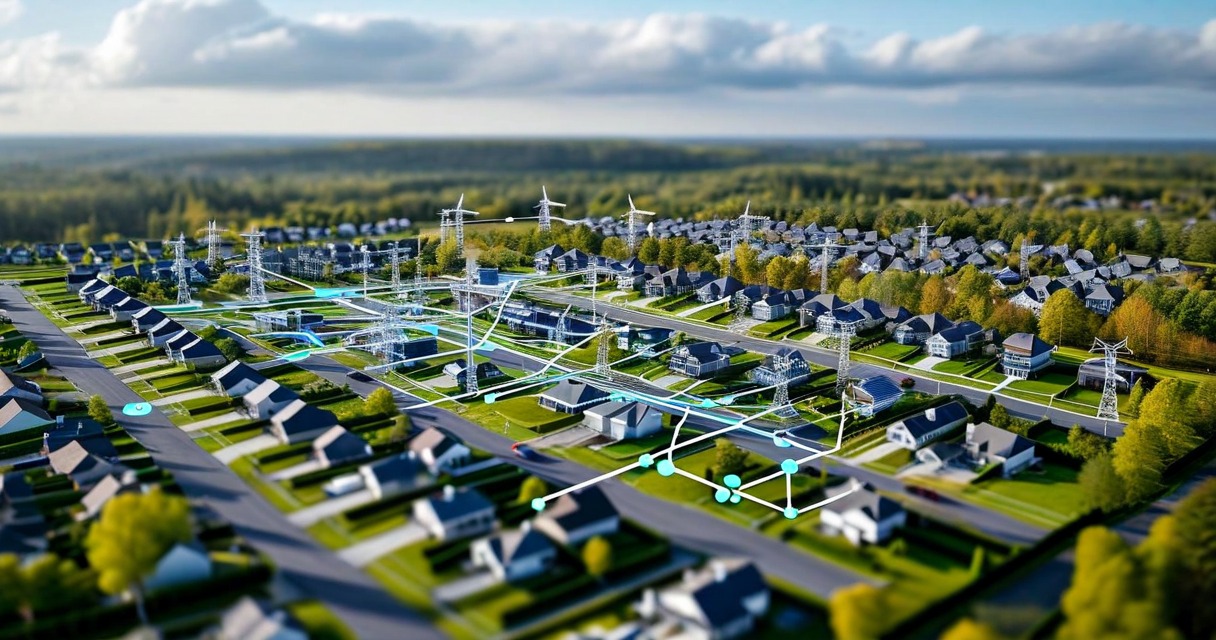
FERC Order 2222, issued in September 2020, opened wholesale electricity markets to aggregated distributed energy resources. The RTO/ISO compliance deadlines have been extending, but the operational implications for distribution utilities and balancing authorities are arriving ahead of full market implementation. Waiting until the tariff changes go live to begin preparation is the wrong timeline.
What Order 2222 Requires and What It Doesn't Specify
Order 2222 requires each RTO and ISO to revise its tariff to allow DER aggregations to participate in all wholesale electricity markets where they are technically capable of performing — energy, capacity, ancillary services, and regulation. The rule applies to aggregations that meet the minimum size thresholds set by the RTO (which may be as low as 100 kW in some markets).
What the order does not specify is how distribution utilities must change their operations to accommodate wholesale DER participation on their distribution systems. FERC's jurisdiction covers wholesale markets; distribution operations are under state PUC jurisdiction. The coordination requirement between the wholesale DER aggregator and the distribution utility — particularly for real-time dispatch signals that affect distribution feeder loading — is being negotiated at the state and RTO level and varies substantially across jurisdictions.
For distribution utilities, the practical concern is that DER assets on their feeders may begin responding to wholesale market price signals or aggregator dispatch instructions in ways that the distribution SCADA system cannot observe or predict. An aggregated portfolio of 500 smart thermostats and 200 battery storage systems that simultaneously responds to a wholesale ancillary services signal can produce a load step change of 5–15 MW on the distribution system with no visibility to the distribution operator.
The Forecasting Problem Order 2222 Creates
Short-interval load forecasting assumes that load is driven primarily by weather, time-of-day, and behavioral patterns that are stable enough to model from historical data. DER aggregations participating in wholesale markets introduce a new load component driven by wholesale market prices and aggregator bidding strategies — a component that is correlated with grid stress conditions (and therefore with the periods when forecast accuracy matters most) rather than with weather or behavioral patterns.
An aggregated battery storage portfolio will discharge into the grid (reducing apparent load and possibly creating net negative feeder load) when real-time LMP spikes above its bid price. This happens precisely during the conditions when the distribution utility most needs accurate load forecasts — high-demand periods with volatile LMPs. A forecasting model that doesn't incorporate knowledge of DER aggregation dispatch will systematically over-predict net load during high-LMP periods, causing dispatchers to take actions based on a load forecast that doesn't reflect the offsetting DER discharge that is already underway.
The data gap is the fundamental challenge: distribution utilities typically don't have real-time visibility into individual DER dispatch events unless they've deployed advanced metering infrastructure (AMI) with 5-minute reads and the telemetry infrastructure to aggregate those reads in near-real-time. Most utilities can identify net feeder load from SCADA, but cannot decompose it into load contribution and DER generation contribution without interval metering on every DER resource.
The Distribution-Transmission Coordination Requirement
Order 2222 created a coordination obligation between distribution utilities and the DER aggregator when DER assets participate in wholesale markets. The specific requirements vary by RTO, but the common elements include: pre-dispatch notification to the distribution utility when the aggregator intends to dispatch (with lead times ranging from 30 minutes to 2 hours depending on the RTO's rules), real-time telemetry sharing between the aggregator and the distribution utility showing aggregate DER portfolio output, and post-event settlement data at the interval level.
For balancing authorities, the additional layer is that DER aggregations participating in regulation or frequency response markets respond on automatic control signals — potentially within seconds — rather than on dispatch instructions with lead time. A battery storage aggregation providing regulation-down service will inject power into the grid in response to an automatic generation control (AGC) signal, with no advance notice to the distribution utility.
Integrating these automatic-response DER signals into balancing authority operational models requires coordination infrastructure that most balancing authorities haven't built yet. The technical path is a DER management system (DERMS) at the distribution level that provides the balancing authority with real-time aggregate output of DER portfolios and receives coordination signals when DER dispatch would create distribution system problems.
Smart Meters as the Data Foundation
Advanced Metering Infrastructure (AMI) — smart meters with two-way communication and interval read capability — is the data foundation for both DER coordination and improved short-interval load forecasting in an Order 2222 environment. Utilities with AMI at 60%+ penetration have the ability to observe load at the meter level in near-real-time, enabling them to distinguish between load changes driven by weather/behavior and load changes driven by behind-the-meter DER dispatch.
The challenge is that AMI data at scale — a 500,000-meter deployment at 15-minute reads generates roughly 1 TB of data per day — requires data management infrastructure that most distribution utilities haven't built for operational (as opposed to billing) purposes. Turning AMI data into a real-time input for short-interval load forecasting requires: automated data quality validation at the meter level, aggregation to the feeder or distribution transformer level on a latency of 5 minutes or less, and integration with the forecasting system's feature generation pipeline.
Utilities that invest in this capability now — ahead of full Order 2222 market implementation — will have a forecasting and operational advantage when DER aggregations begin actively participating in wholesale markets. Those that wait will find themselves reacting to forecast errors they can't explain, caused by load components they can't observe.
Demand Response Programs Under Order 2222
Existing utility DR programs face a competitive environment under Order 2222: DER aggregators can now offer demand-response-equivalent capacity directly into wholesale capacity markets, potentially recruiting customers away from utility-run programs. Utilities that have built strong DR programs with direct customer relationships and established dispatch infrastructure are in a better position than those that have relied on third-party aggregators as intermediaries.
The practical implication is that demand-response program optimization — improving dispatch reliability, reducing participant fatigue, and demonstrating concrete value to enrolled customers — is now a competitive activity, not just an operational one. As we discuss in our analysis of OpenADR 2.0b dispatch sequencing, program reliability depends heavily on dispatch logic quality, not just on enrollment numbers.